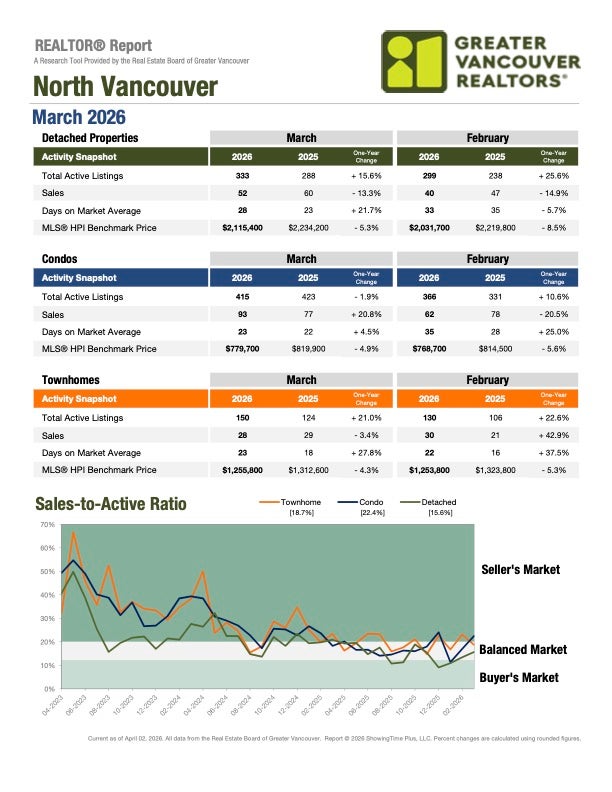

The latest data from Greater Vancouver REALTORS shows a Metro Vancouver housing market that continues to stabilize, with both buyers and sellers taking a more cautious, “wait-and-see” approach as we head into the spring season.
Sales Activity Remains Subdued
In March 2026, a total of 2,032 homes sold across Metro Vancouver, marking a modest 2.8% decrease compared to March 2025. More notably, sales remain 31.8% below the 10-year seasonal average, highlighting ongoing softness in overall demand.
While activity is similar to last year, it reflects a market still adjusting to higher borrowing costs and broader economic uncertainty.
Listings Decline While Inventory Stays Elevated
New listings saw a noticeable dip, with 5,792 properties added to the market, down 10.3% year-over-year. However, total inventory remains relatively high at 14,774 active listings, sitting 38% above the 10-year average.
This dynamic—fewer new listings but elevated overall supply—continues to keep the market balanced, preventing significant price swings.
A Balanced Market Overall
The sales-to-active listings ratio sits at 14.2%, placing Metro Vancouver firmly in balanced market territory.
Detached homes: 11% (slightly leaning buyer’s market)
Townhomes (attached): 17.2%
Apartments: 15.7%
Historically, prices tend to decline when this ratio falls below 12% and rise when it exceeds 20%. Current levels suggest stable pricing conditions.
Prices Hold Steady with Year-Over-Year Declines
The benchmark price for all residential properties is now $1,104,300, down 6.8% from March 2025, but showing a slight 0.4% increase month-over-month.
By Property Type:
Detached homes:
Benchmark: $1,854,800
↓ 8.2% year-over-year
↑ 1% month-over-month
Apartments:
Benchmark: $706,700
↓ 7.8% year-over-year
↓ 0.2% month-over-month
Townhomes:
Benchmark: $1,047,100
↓ 5.7% year-over-year
↑ 0.1% month-over-month
Overall, while prices are still below last year’s levels, they are showing signs of short-term stabilization.
Emerging Trend: Detached Market Showing Strength
One of the most notable developments is a divergence between property types:
-Detached home sales increased by 8.3% year-over-year
-Apartment and townhome sales declined
This could signal renewed interest in detached properties, potentially driven by improving confidence among move-up buyers or limited supply in this segment.
Economic Factors Shaping the Market
Several external factors are influencing buyer behaviour:
-Elevated mortgage rates, influenced by rising bond yields
-Global geopolitical uncertainty, particularly conflicts impacting financial markets
-Lingering caution despite reduced tariff concerns compared to early 2025
These factors are expected to temper demand through the spring market, unless conditions shift quickly.
What This Means for Buyers and Sellers
For Buyers:
-More choice than in recent years due to higher inventory
-Stable pricing environment reduces urgency
-Opportunity to negotiate, especially in the apartment segment
For Sellers:
-Pricing strategy is critical in a balanced market
-Detached homes may see stronger demand relative to other segments
-Patience may be required as buyers take longer to make decisions
The Metro Vancouver real estate market in March 2026 is defined by balance and caution. While sales remain below historical norms, stable inventory levels and modest price movements suggest the market is finding its footing.
As we move deeper into the spring season, all eyes will be on interest rates and broader economic conditions to determine whether activity picks up—or remains steady.